Classification of the 1878 Morgan Silver Dollar relies on changes in the reverse design.
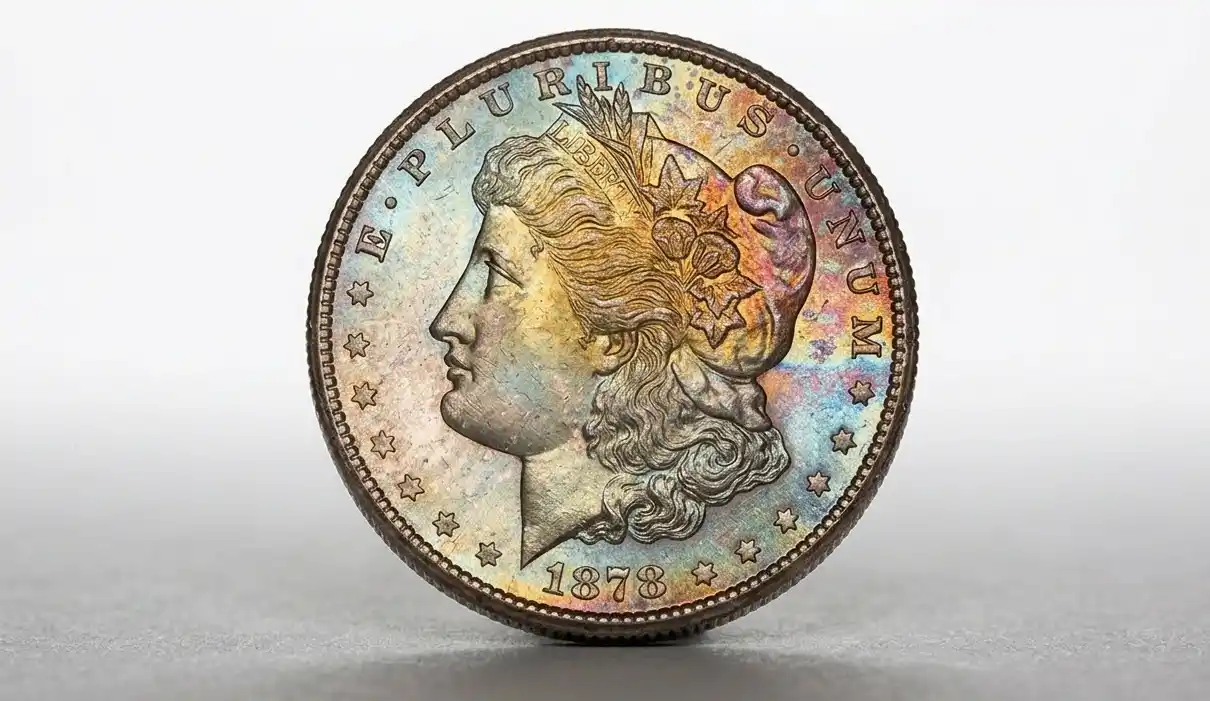
Differences in the eagle’s tail feathers determine the market category for every specimen.
| Parameter | Measurement |
| Mass | 26.73 grams |
| Diameter | 38.1 millimeters |
| Composition | 90% silver and 10% copper |
| Philadelphia Mintage | 10,500,000 units |
| Carson City Mintage | 2,212,000 units |
| San Francisco Mintage | 9,774,000 units |
8 Tail Feathers Variety (8 TF)
Initial reverse designs featured eight feathers in the eagle’s tail.
The Mint changed the feather count shortly after commencing production.
This version originated only from the Philadelphia facility.
Absence of a mint mark confirms the origin from the main branch.
High demand for this category stems from its status as the first type.
- EF40 Condition: $165
- MS60 Condition: $480
- MS65 Condition: $3,100
- Record Price MS67: $38,400
Annual value growth for MS65 preservation reaches 6%.
Market dynamics → Increasing rarity in high grades → Rising auction bids.
7 over 8 Tail Feathers Variety (7/8 TF)
Using old dies resulted in the new design being impressed over the previous one.
Tips of eight feathers remain visible beneath seven newer feathers.
Numismatists identify several subtypes depending on the clarity of the doubling.
Strong manifestation of the lower feathers increases the estimated lot value.
- Weak doubling of feathers
- Moderate detail visibility
- Strong doubling (Strong 7/8)
| Condition | Price for 7/8 Strong | Price for 7/8 Weak |
| MS60 | $410 | $340 |
| MS63 | $750 | $580 |
| MS65 | $3,450 | $2,900 |
Price reduction when moving from Strong to Weak equals 18%.
Applying a coin checker app allows for precise subtype identification.
7 Tail Feathers Variety (7 TF)
Finalized design versions for 1878 contain seven tail feathers.
A flat eagle breast and a parallel top feather on the arrow characterize this type.
This configuration is known as the Second Reverse of 1878.
All three active mints produced this specific configuration.
- Philadelphia (No mark)
- San Francisco (S)
- Carson City (CC)
Carson City rarity factor → Limited supply → High baseline price.
Reverse of 1879 on 1878 Coins
Late in the year, the Mint began using the updated design intended for the next period.
A rounded eagle breast and a slanted top arrow feather distinguish this variety.
Identifying this type requires a detailed inspection of the plumage.
| Mint | MS63 Condition | MS65 Condition |
| Philadelphia | $1,150 | $7,200 |
| San Francisco | Non-existent | Non-existent |
| Carson City | Non-existent | Non-existent |
This design error occurs exclusively on Philadelphia production.
Record sale of a specimen in MS66 preservation reached $41,125 in 2024.
Investment appeal over the decade grew by 85%.
Comparison of Different Mints
Placement of the mint mark occurs under the wreath above the letter D in DOLLAR.
Missing marks indicate Philadelphia.
Letter S corresponds to San Francisco.
Letters CC designate Carson City.
- 1878-S: Most accessible option in high quality.
- 1878-CC: High value even in worn condition.
- 1878-P: Variety of reverses creates price variance.
Price stability for 1878-S results from the excellent preservation of the mintage.
Price drops for low grades average 2% annually due to supply surplus.
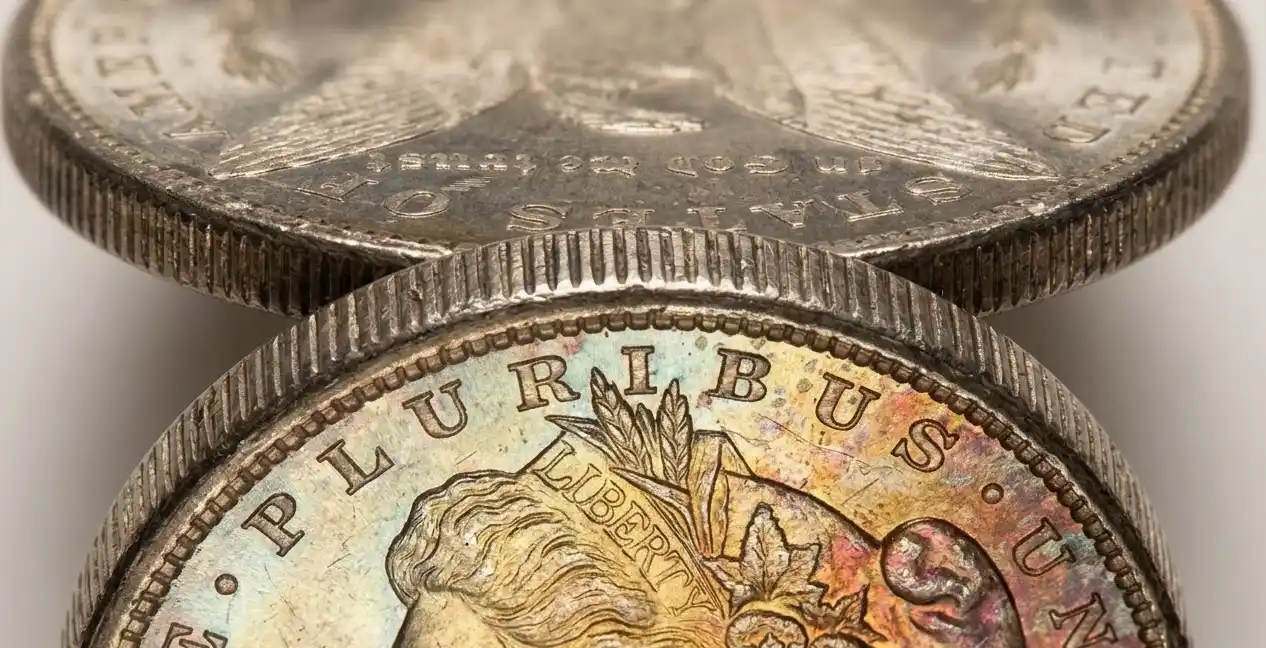
Reverse of 1878 vs Reverse of 1879 Features
Arrow geometry and bird breast shape serve as key indicators.
Straight arrow fletching characterizes the early type.
Curved upper arrow fletching indicates the late type.
Parallel feather → Reverse of 1878.
Slanted feather → Reverse of 1879.
Price difference between these two types at identical grades reaches 250%.
Sheldon Scale Grading and Condition Analysis
A scale from 1 to 70 determines the physical integrity of the metal.
Presence of mint luster elevates the lot category.
Wear on the hair above Liberty’s ear and on the eagle’s breast reduces the grade.
- G4: Heavy wear, letters merging with the rim.
- VG8: Details visible but heavily flattened.
- F12: Major hair lines remain noticeable.
- VF20: Half of the hair details remain discernible.
- XF40: Slight wear on the highest points only.
- AU50: Traces of circulation on relief peaks.
- MS60: No circulation wear, many small marks.
- MS65: Superior luster, minimal contact marks.
Using a microscope helps detect traces of cleaning.
Chemical alteration negates the numismatic premium.
Production and Minting Errors
Manual engraving of master hubs led to microscopic differences.
The VAM catalog describes hundreds of unique die states.
VAM 9 with tripled reverse imagery fetches $1,200 for MS63.
VAM 14-A with a die crack adds 40% to the base price.
Reasons for variety emergence:
- Design experiments during the first month of operation
- Use of improperly prepared tools
- High press pressure due to large mintages
- Resource saving by reworking old dies
Manufacturing defects create additional value for researchers.
San Francisco and Striking Quality
This mint produced coins with deep mirrored luster in 1878.
PL (Proof-Like) designations add 50% to the price.
DMPL (Deep Mirror Proof-Like) designations double the value.
- 1878-S MS63: $145
- 1878-S MS63 PL: $220
- 1878-S MS63 DMPL: $490
Metal purity and press pressure in San Francisco were considered benchmarks.
The metal demonstrates high resistance to toning.
Certification and Authenticity Protection
Professional evaluation eliminates the risk of acquiring counterfeits.
Leading companies provide guarantees on grade and authenticity.
Service costs in 2026 vary from $35 to $150, but you can use the free coin value checker app.
- Determining alloy authenticity
- Identifying hidden restorations
- Assigning a numerical value
- Hermetic sealing in plastic
Presence of holographic protection and a unique code is mandatory.
Checking the database confirms the sale date and previous owner’s price.
Storing Numismatic Objects
Environmental factors affect the chemical stability of the silver.
High humidity causes the appearance of dark spots.
Using acid-free holders prevents corrosion.
Temperature ranges within 18-22 degrees Celsius are considered optimal.
- Safe with humidity control
- Individual capsules made of inert plastic
- Absence of direct sunlight
- Use of gloves when examining without a capsule
Violating storage rules reduces the grade by 1-2 points.
This equals a 30% loss in value for expensive positions.